What an AI-drafted order ticket must show before confirmation
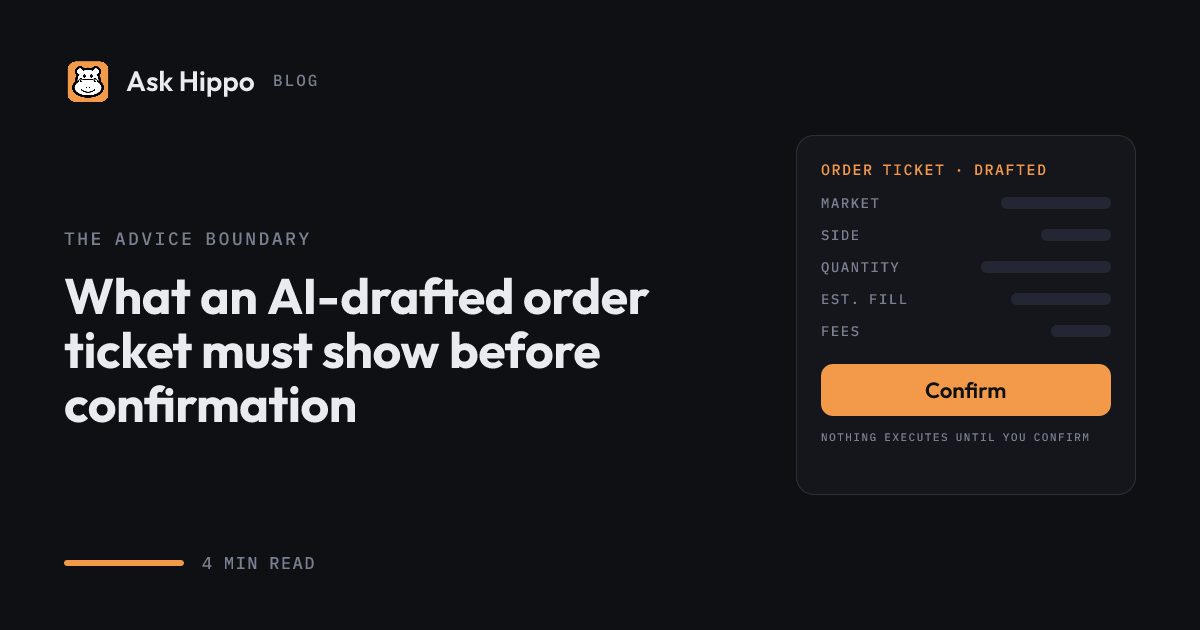
An AI-drafted order ticket must show the market, symbol, side, order type and quantity, with the quantity echoed in the trader’s own terms. It also shows estimated fill and fees. For leveraged orders it adds the margin used and the estimated liquidation price. Estimates are labelled as estimates, and nothing executes until the trader confirms.
The ticket is where a conversation becomes an order. Natural language is ambiguous; the ticket is the moment that ambiguity is removed and the trader checks the result. This guide lists each field, explains why it is there, and works through a spot and a leveraged example.
Examples use illustrative prices.
Why the ticket matters
When a trader types “sell half my ETH”, the agent has to resolve several things. Which market? Market or limit? Half of the balance, or half of an open position? The ticket shows every resolved choice so the trader can see exactly what will happen.
That makes the ticket part of the advice boundary. The agent drafts. The trader decides. See why confirm-by-default matters for the wider reasoning.
Every field, and why
| Field | What it shows | Why it is there |
|---|---|---|
| Market | Spot, or the derivatives contract type | “ETH” could mean spot ETH or an ETH perpetual; the risk is very different |
| Symbol | The exact pair or contract, such as ETH-USDT | Settles which quote currency and which instrument |
| Side | Buy or sell; for derivatives, long or short | The single most costly field to get wrong |
| Type | Market, limit, stop or stop-limit, plus any limit or trigger price | Decides whether and at what price it fills; see order types explained |
| Quantity, echoed | The exact amount, restated in the trader’s terms | Catches misread relative instructions like “half” or “the rest” |
| Est. fill | The estimated average price, and the resulting value | Shows the expected cost or proceeds before committing |
| Fees | The estimated fee, in currency | Fees change the result, especially on frequent or large orders |
| Margin (leveraged) | Leverage, and the margin the order will use | Shows how much collateral is committed |
| Est. liquidation (leveraged) | The estimated price at which the position would be liquidated | Shows how far price can move against the position |
| Footer | “Nothing executes until you confirm.” | States plainly that the order has not been sent |
Fees and contract rules vary by venue. Check your venue’s contract specification for exact values.
The quantity echo
Relative instructions are where most drafting errors would happen. “Half”, “a quarter”, “the rest” and “$500 worth” all need converting into an exact quantity.
The echo restates the result in both forms: the exact amount and the trader’s own framing. For example:
Sell 0.5 ETH (50% of your 1.0 ETH)
If the trader meant half of a different balance, the mistake is visible before anything happens. An echo that shows only “0.5 ETH” leaves the trader to do that check in their head.
Worked example: spot market sell
The trader holds 1.0 ETH and types “sell half my ETH at market”. Assume a best bid of $3,000.00 with enough depth to fill, and an illustrative taker fee of 0.10%.
- Quantity: 1.0 ETH × 50% = 0.5 ETH
- Est. value: 0.5 × $3,000.00 = $1,500.00
- Fees: $1,500.00 × 0.10% = $1.50
- Est. proceeds: $1,500.00 − $1.50 = $1,498.50
The ticket:
| Field | Value |
|---|---|
| Market | Spot |
| Symbol | ETH-USDT |
| Side | Sell |
| Type | Market |
| Quantity | Sell 0.5 ETH (50% of your 1.0 ETH) |
| Est. fill | ~$3,000.00 per ETH, ~$1,500.00 total |
| Fees | ~$1.50 (est.) |
| Est. proceeds | ~$1,498.50 |
| Nothing executes until you confirm. |
The fill is an estimate because a market order takes whatever the book offers on arrival. A larger order in a thinner book could fill lower; see slippage explained.
Worked example: leveraged perpetual long
The trader types “long 0.1 BTC on the perp at 10x, market, isolated”. Assume an estimated entry of $60,000.00, an illustrative taker fee of 0.05%, a maintenance margin rate of 0.5%, and 2,000.00 USDT of available margin.
- Notional: 0.1 × $60,000.00 = $6,000.00
- Initial margin: $6,000.00 ÷ 10 = $600.00
- Share of available margin: $600.00 ÷ $2,000.00 = 30%
- Fees: $6,000.00 × 0.05% = $3.00
- Maintenance margin: $6,000.00 × 0.5% = $30.00
- Loss the margin can absorb: $600.00 − $30.00 = $570.00
- Price move to absorb it: $570.00 ÷ 0.1 = $5,700.00
- Est. liquidation: $60,000.00 − $5,700.00 = $54,300.00, which is 9.5% below entry
The ticket:
| Field | Value |
|---|---|
| Market | Perpetual futures |
| Symbol | BTC-USDT perpetual |
| Side | Buy / Long |
| Type | Market |
| Quantity | Long 0.1 BTC (notional ~$6,000.00) |
| Leverage and mode | 10x, isolated |
| Margin | $600.00 (30% of your 2,000.00 USDT available) |
| Est. fill | ~$60,000.00 per BTC |
| Fees | ~$3.00 (est.) |
| Est. liquidation | ~$54,300.00 (est.) |
| Nothing executes until you confirm. |
This is a simplified calculation. It leaves out fees in the liquidation maths, funding, tiered maintenance rates and mark-price rules, which is why the ticket labels it an estimate. The full method is in leverage, margin and liquidation explained.
Labelling estimates honestly
Three fields are always estimates: fill price, fees and liquidation price. Marking them with “est.” or “~” does two jobs. It sets the trader’s expectations, and it keeps the agent from stating something it cannot know as a fact.
A ticket that shows “$54,300.00” without a label implies a certainty the venue’s own engine does not offer.
How Hippo’s ticket works
Hippo drafts the order and shows it on its own order ticket inside the chat, with the fields above. The trader confirms there, and Hippo then submits the order through the exchange’s API. Confirmation is mandatory, not a setting.
Related
For the boundary behind the ticket, read information vs investment advice and why Hippo explains and never advises. To check a vendor’s ticket, use the vendor checklist. More at askthehippo.com.
Frequently asked questions
What is a quantity echo on an order ticket?
A restatement of the resolved quantity in the trader's own terms, such as 'Sell 0.5 ETH (50% of your 1.0 ETH)'. It lets the trader check that a relative instruction like 'half' was read correctly before confirming.
Why are fill price and liquidation price labelled as estimates?
A market order fills at whatever the book offers when it arrives, and liquidation depends on mark price, fees, funding and tiered maintenance margin. The ticket can only estimate both, so it says so.
Which extra fields does a leveraged order ticket need?
At minimum the leverage, the margin the order will use, and the estimated liquidation price. Many designs also show the margin mode, isolated or cross, and the position's notional value.
Can a trader skip the confirmation step for small orders?
In a confirm-by-default design, no. Confirmation applies to every order regardless of size, and there is no setting to turn it off.
Hippo provides information, not investment advice.
Part of our guide: How an AI trading agent avoids giving investment advice